This digital publication was supported by the Leventhal Map & Education Center's Small Grants for Early Career Digital Publications program.
The Great Elm
In 1876, a fierce winter storm toppled the Great Elm of the Boston Common: an iconic local landmark known and cherished by Bostonians for centuries.

Excerpt of “The Great Elm on Boston Common: Destroyed February 15th 1876,” lithograph, Prints and Photographs Department, Collection of the Boston Athenaeum
According to speculation at the time, the magnificent tree—which was recorded as 72.5 feet high with a canopy of 101 feet in 1855—stood near the center of the Boston Common for at least two centuries before it fell.1 Some Bostonians speculated that the elm may have predated European settlement, which allowed them to imagine it as a symbolic witness to the city’s entire history. Then, when the Great Elm fell in 1876, its death coincided with the centennial of the United States.
For many, this serendipitous timing solidified the tree’s cultural and historical significance. Poets wrote loving paeans to the tree. Citizens carved off portions of its fallen wood to create souvenirs and keepsakes, including the “Old Elm” chair that is still housed in the Boston Public Library’s Special Collections. Made from a branch of the elm, the chair has an intricate rendering of the tree carved on its backrest. In 1876, Robert Cassie Waterston wrote from the perspective of the elm as an anthropomorphic historian in Story of The Old Elm on Boston Common. Cassie’s tree narrator provided a sweeping history of the city that spanned from Indigenous inhabitation pre-European contact, to the American Revolution, into the (then) present day of 1876. For many Bostonians, such accounts transformed the Great Elm into not only an iconic symbol of Boston, but of the United States at large.
Trees across time
This project, “Trees Across Time: An Arboreal History of the Boston Common,” also centers the lives of trees to contemplate the entangled relationships between plants and people. Like Waterston’s tale, “Trees Across Time” narrates the history of the Boston Common with trees as the main characters. Rather than understanding trees as passive objects in the background of human history, this project considers trees important figures in their own right. While humans have exerted great influence on the trees of the Boston Common, the many trees within this landscape have also profoundly shaped human culture, as well as the physical environment surrounding them.
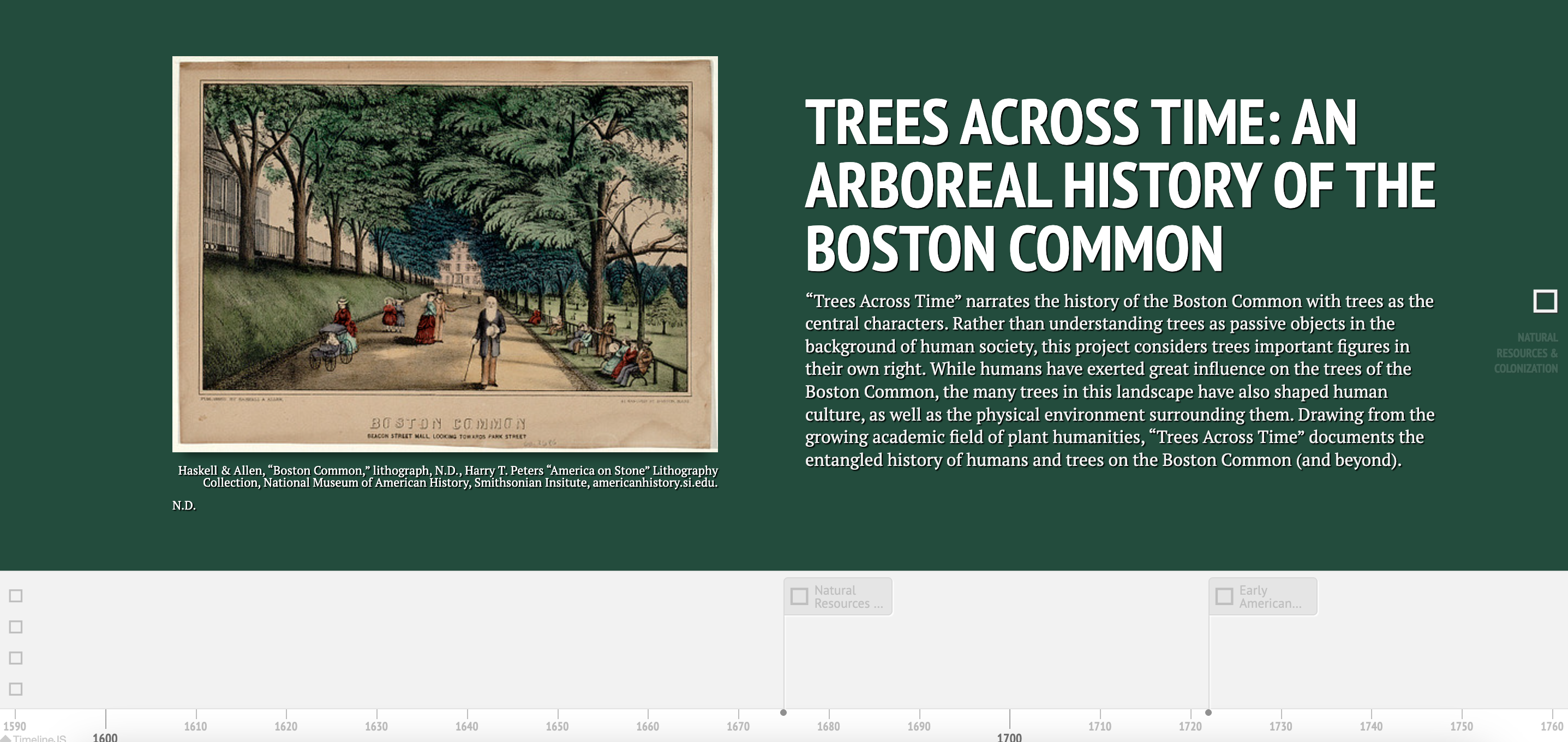
Trees Across Time, by Amanda Martin
Drawing from the academic fields of plant humanities and environmental history, “Trees Across Time” uses maps and images of Boston Common trees to better understand how the relationship between plants and people in Boston has transformed (and in some cases–remained similar) from the seventeenth century to the twenty-first century. This project adopts the framework of “plant humanities” introduced in 2018 by the Dumbarton Oaks’ Plant Humanities Initiative, which calls for “plant stories that are historically precise, geographically situated, and convey the interplay between place and mobility in plant-human relationships.”2 “Trees Across Time” embraces a similar methodology to the Plant Humanities Lab by utilizing primary sources and plant archives to create environmental history narratives that can provide new insights about the relationship between plants and people. This task is more important than ever during our current moment of climate crisis.
As a result, “Trees Across Time” poses the following research questions:
Who are the subjects and actors of environmental history? Are they only human, or can we also understand more-than-human species such as plants as historical actors? If so, how can we historicize plants not as passive background material to human life, but as organisms with meaningful biological and cultural influence?
What types of environmental archives can help us understand the histories of plants and people? How can using visual archival sources (such as maps, landscape illustrations, and photographs) help us to better understand both the physical presence and the cultural meanings of trees on the Boston Common (and elsewhere)?
How might narrating historical timelines from a “plant perspective” differ from narrating them from a human perspective? Humans tend to narrate our history through well-known human-centric events (i.e., the American Revolution). How might trying to construct a historical narrative based on plants look different? A single elm tree can live for hundreds of years, which can challenge our paradigm of human timescales. How does thinking in tree time provide us with new historical perspectives?
Methods
In terms of structure, this project bridges digital humanities and plant humanities by using TimelineJS by Knight Lab. Adopting this linear model provides a clearer narrative sense of how both the physical presence and the cultural meanings of trees have changed over time on the Common. This includes a gradual but significant shift from agrarian to recreational land uses of the Common, which was underscored by the City’s tree-planting initiatives that began in the late eighteenth century. The timeline structure also highlights some unexpected and fascinating continuities over time. For example, both urban reformers in the mid-nineteenth century and climate justice advocates in the twenty-first century have considered parks important sites of public health. The former understood that leafy green spaces provided rare fresh air in the rapidly industrializing city, while the latter now understand that shade trees help mitigate the urban heat island effect.
“Trees Across Time” is not alone in considering how tree histories might productively upend our prevailing ideas about human histories. In fact, the idea of “witness trees” is fairly common in American history. In 1949, the famous conservationist Aldo Leopold also contemplated the relationship between trees and history when felling an oak tree on his farm in Wisconsin. In his book A Sand County Almanac: And Sketches Here and There, Leopold describes the old oak as an eyewitness to history–much as nineteenth century Bostonians imagined the fallen Great Elm. As Leopold slices into the tree, he perceives the oak itself as an organic timeline: “Now our saw bites into the 1920’s…when everything grew bigger and better in heedlessness and arrogance—until the stock market fell in 1929.” “We cut 1899, when the last passenger pigeon collided with a charge of shot near Babcock, two counties to the north.” After the tree fell, Leopold counted 80 tree rings, indicating that the tree likely sprouted in 1865: the final year of the Civil War. While considering the fallen tree, he concluded that “the stump yields a collective view of a century,” and finally, “the tree attests to the unity of the hodge-podge called history.”3 Similarly, “Trees Across Time” narrates the vibrant history of the Boston Common (and beyond) by centering the lives, stories, and legacies of its trees.
Amanda Martin is a historian of the twentieth century United States who specializes in environmental history. She is broadly interested in understanding how green spaces—whether urban parks, gardens, or remote outdoor resorts—have become sites of significant social, political, and environmental history. Amanda has published her work in Environmental History, the Washington Post, Environmental History Now, Zócalo Public Square, and “Mapping Inequality: Redlining in New Deal America.” Amanda also practices public history, and has experience leading walking tours, curating museum exhibits, producing podcasts, and creating digital map projects. You can visit her website to learn more about her work.
Notes
1. “The Great Elm on the Boston Common,” State Library of Massachusetts Blog.
2. “About,” Plant Humanities Lab, Dumbarton Oaks.
3. Aldo Leopold, A Sand County Almanac. And Sketches Here and There (New York: Oxford University Press, 1949), 12.
Further reading
Beamish, Anne. “Venerable Relic: The Great Elm on the Boston Common,” Arboricultural Journal 39, no. 3 (2017): 144–61.
“Boston Common.” History of Early American Landscape Design. National Gallery of Art.
Cronon, William. Changes in the Land: Indians, Colonists, and the Ecology of New England. 1st rev. ed., 20th-Anniversary ed. Hill and Wang, 2003.
Fisher, Chad. “Exploring Tree Equity in Boston.” ArcGIS StoryMaps. August 10, 2023.
Jones, Owain. Tree Cultures: The Place of Trees and Trees in Their Place. With Owain Jones. Berg, 2002.
Oswald, W. Wyatt and Andrew D. Richardson. “Tracking the Seasonal Rhythms of Boston Common Trees.” Arnoldia 73, no. 2 (2015): 36–39.
Our articles are always free
You’ll never hit a paywall or be asked to subscribe to read our free articles. No matter who you are, our articles are free to read—in class, at home, on the train, or wherever you like. In fact, you can even reuse them under a Creative Commons CC BY-ND 2.0 license.