We’re excited to introduce Kate Lautenbach to the LMEC community as our Fall 2025 GIS & Geohumanities Assistant! Kate joined us this July as a Northeastern Co-op student and is currently an undergraduate candidate for a BA in Data Science and International Affairs. Now at the end of her co-op term, we sat down with Kate to learn more about her earliest memories of maps, work at the Center, and how an unexpected piece of advise helped guide her through the co-op.
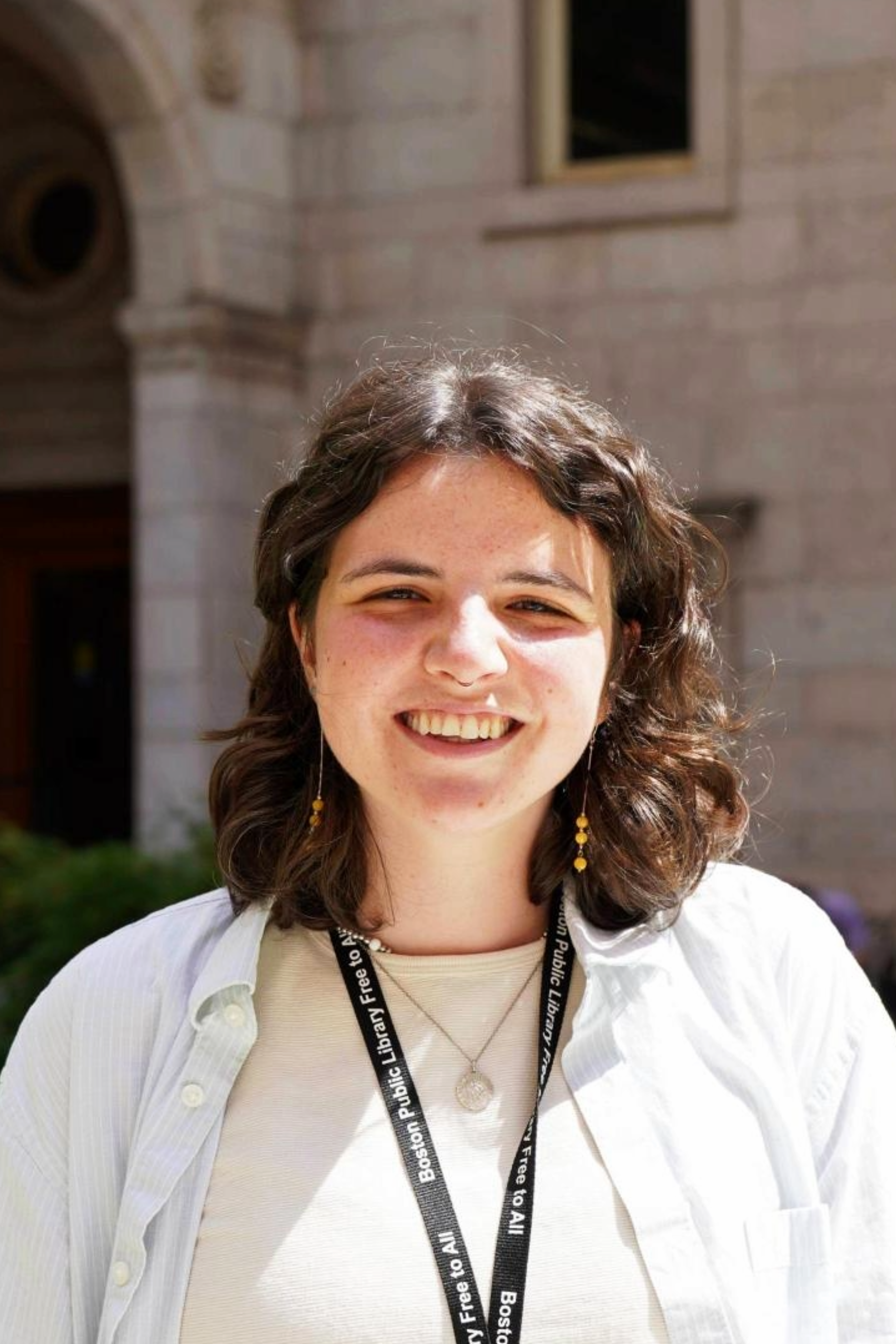
Kate, we loved having you as an essential piece of the Leventhal Map & Education Center team and the first ever GIS & Geohumanities Assistant! We’re curious, what are you currently studying at Northeastern and what made you choose to work at the Leventhal Center during your co-op experience?
I am pursuing a combined degree of Data Science and International Affairs with a minor in English. I considered these majors with a future goal of eventually getting a master's in Library Science. When looking for a co-op, I wanted something that would build on my skills in data science, as well as focusing on a topic that captured my interests, with a foundation in humanities work. When looking at job descriptions, the Geohumanities & GIS Assistant description contained both skills I wanted to practice for future jobs and classes, including tasks in data collection, archiving, and working with metadata, and had a humanities focus.
When I was lucky enough to get an interview at the Center, this co-op solidified itself as my top choice. Before the interview, I looked at the recent exhibition Processing Place, which happened to overlap a bit with the job and discussed the history of digital mapping. I was fascinated both by the exhibition content and by the realization that “maps” can define many more things than I previously thought. Discussing the specifics of the position and the possible projects I could work on was also exciting, and there seemed to be a lot of space to work on projects that aligned with my personal interests, including being able to decide some of my larger projects during the co-op experience.
What projects have you worked on during your co-op? Was there anything that surprised you or something unexpected that you learned from working on those projects?
My co-op has consisted of a fair amount of georeferencing. Early on, I helped complete the Clough 1798 atlas (now live on Atlascope), an atlas that was actually created in the early 1900s as a historical project. In that work, I’d been looking in really close detail at Boston's streets, and what really continues to amazes me is the lack of change that has happened in neighborhoods like Beacon Hill and the North End. Of course, in contrast, there has been a massive amount of change in Back Bay, and learning the ins and outs of Boston's street history through this project has been really cool.
I have also been working on building my base understanding of the tools and history of GIS (Geographic Information Systems). When in school, core Data Science classes cover some GIS material, but there’s no focus on the history or politics of the practice nor any in-depth exploration into the subject itself. Learning the base ideas and the most popular tools, as well as how to contextualize them, has been rewarding, as I am thoroughly learning this topic rather than quickly proving proficiency in it, but also fascinating to see where things like art, history, and the economy intersect with my work.
Though you’re the Geohumanities & GIS Assistant, you’ve spent part of your time as a gallery attendant. Are there any parts of the gallery or current exhibition that you’re especially drawn to?
It has been unexpectedly fun to lead tours in the gallery and to learn fun facts about Boston's geography. In the Terrains of Independence exhibition, I really enjoy the first map inside the gallery, A new map of North America. I start my tours with this map and it adds good geographical context to the Revolution. Starting from the small tip of England pictured in the top right corner to the winds that lead down to the Caribbean, and the pictured port cities that include Boston in the bottom left, this map helps center the American Revolution in geography rather than just dates and events, which is helpful for the exhibition.
In the Becoming Boston exhibition, within the eight different sections, my favorite niche is “Resistance and Resilience.” I like that many of the maps in this exhibition are pieces of history themselves, some of them even being the first of their kind. The Short-term plan to reduce racial imbalance in the Boston Public Schools is an early computer-aided map that was published just before the ruling that called for the desegregation of schools in Boston to happen immediately. The other map in this section, Illustrative site plan: Washington Park urban renewal area, tells a story of Boston in that 1970s, emphasizing the racism that affected change and growth in particular communities, and the stories that go untold.
I am drawn to maps in the collection like this, ones with surprising histories that challenge conceptions of a place. Alongside that, I can see these Boston-area maps with the perspective as someone who is not from Boston. Because of that, I’m able to consider how these maps can change the perspective of those visiting from out of town, and challenge their ideas of what is important in Boston’s history beyond the colonial period.
What is your earliest memory of maps? Have maps influenced your life in any particular way as an adult?
As is true with everything that has influenced me as an adult, the first (and maybe only) person who talked passionately about maps, and contributed to my devotion to them, was my mother. While she outright refuses to use any GPS technology, I remember her looking at any and all physical maps that were available; she always picked one up, pointed to where we were, and where we were going. On one of the earliest road trips that we took, from Indianapolis to Dauphin Island, Alabama, I remember a large map of the Americas that my mom found in a rest stop being used for car navigation. Beyond that, every trail, museum, and city we visited, my mom would (and still does!) keep a pocket map in her purse. She rarely remembers it's there, yet insists on needing it.
My first time using a map, rather than seeing one being used while sitting disinterested in the very back of the car, was in fourth grade, when people started looking up their home addresses on Google Maps for fun. I definitely did not associate it in my mind as a mapping or geographic activity; however, now that I’m working with maps, I realize it most definitely was. It was one of the few websites that was not blocked on school computers and it was a welcome distraction for my friends and I from class. Now I spend hours a day looking at street view data of Massachusetts. I feel like those moments were prophetic.
Do you have a favorite map that you’ve found in the collections?

I have a few favorite maps; it was too hard to pick one. The first is a street map of Indianapolis from the early 1900s. This map was made by The National Map Company, which made maps covering all across America. This map in particular highlights the “main” roads of the city, as well as the inter-urban railway, with routes very similar to the bus network in use now, and the city limits at the time, just a few miles inward from the current city limits. It's just good fun to see an old map of where you grew up or where your family has roots, which is why I had to choose this map. For me, it’s interesting to look at what they decided to add and exclude, what areas were not densely populated then and what’d now changed, and viewing what areas were important/heavily populated and how it looks very similar to today.
My other favorite map, or collection of maps, is a series of pictorial maps that reimagine European countries as individual people, created by Lilian Elizabeth Lancaster in the 1860s. The people are dressed as they depict their country, and there is a short poem at the bottom of each page about the country being depicted. here’s an example if one of the poems about Ireland:
“And what shall typify the Emerald Isle?
A peasant, happy in her baby’s smile?
No fortune her’s, — though rich in native grace,—
Herrings, potatoes, and an English face.”
This poem shows the bias of the English author, as this was written in the years after the decimation of Ireland and its population from the the potato famine, a catastrophe made exponentially more fatal by the English. The depiction of the Irish as poor peasants dependent on potatoes was a direct outcome of British colonization and their total control of Irish farm lands. Because of the nature of our collections having been acquired over many decades, many of our maps have English and colonialist bias embedded in them. While this collection of pictorial maps is charming and obviously made for entertainment rather than utility, the maps hold a lot of cultural perceptions from the English which was then projected onto the colonial world that they considered their own. I just find it fascinating!
As you reflect on your time at the Leventhal Center, what aspects of your everyday work most excited you?
I appreciated the mix of humanities-focused and computer-focused projects. I curated a From the Vault collection showing program, “Maps in Disaster,” focused on maps that document different landscapes that have been struck by earthquakes, fires, floods, and hurricanes. I also wrote an article about my recent project using Massachusetts’ tax assessor data to estimate the date of construction for every building in Boston. The interactive map presents them in a color scale inspired by Bert Spaan and the Waag Society. I wrapped up my work at LMEC by writing an Atlascope tour about queer literary figures in the greater Boston area between 1850 and 1950.
How do you see this co-op informing or influencing your life post-college and your future career?
This truly is a combination of humanities and data science that I did not know existed before I applied to this position. I am so grateful that I found this opportunity, and my projects are so interesting. Working in a map library is an undeniably unique experience, and while niche, there are so many skills I’m being exposed to that will not only help me build for transferable work skills suited for other industries, but also opens me up a field I hadn’t known existed. I learned to use new interfaces like GQIS and how to work with geographical data. The depth of working with this data type and performing analysis in my projects within this subsection of data science would be unachievable in my regular classes as an undergraduate student. Being here has not only been useful, but inspiring and I’m eager to further explore this new career path I had not considered or knew existed before my time at the Leventhal Center.
Aside from your regular duties and work responsibilities, what was your favorite part about working at the LMEC?

My favorite part was working in a building with so much constantly going on. As a community center, the BPL is always filled with performers, events, and collections that are hard to find elsewhere. It was fascinating to see not only the work happening in the Leventhal Map Center, but also everything happening across the larger library. For example, I got to see Yo-Yo Ma perform at the café, listen to musicians in the courtyard throughout the summer, and sit in on lectures and project presentations at LMEC, like Highlights From The Vault — Creepy Cartography (my favorite map from that collection was a 1500s world map showing cannibalism in the cartouches). Being a part of a place and community doing meaningful, creative work that I’m genuinely proud of was the best part of this co-op experience.
As your co-op comes to an end, do you have any advice for future LMEC co-ops?
I have two main pieces of advice that guided me through my co-op. The first is a quote from my colleagues at the Leventhal Center:
“There are no map emergencies.”
Starting a professional job for the first time felt intimidating, but the LMEC staff helped it feel relaxed, and created a great learning experience rather than just a job. That quote helped calm my nerves many times when things didn’t go as planned. My second piece of advice is to lean into what interests you. There’s a lot of flexibility in choosing projects during a co-op at LMEC, and asking to work on something you’re genuinely excited about only makes the experience, and the final project, better.
Our articles are always free
You’ll never hit a paywall or be asked to subscribe to read our free articles. No matter who you are, our articles are free to read—in class, at home, on the train, or wherever you like. In fact, you can even reuse them under a Creative Commons CC BY-ND 2.0 license.