Teaching Boston: Declaring a New Nation
This new BPS Humanities newsletter feature is designed to demonstrate to students how history happened here in Boston. All of these primary sources come from Boston institutions within a mile of each other: the Museum of Fine Arts, Boston, the Massachusetts Historical Society, and the Norman B. Leventhal Map and Education Center at the Boston Public Library.
In 1776, people across the colonies were debating big questions:
What should this new nation become?
Who should have rights and power?
How do people persuade others to listen to them?
These primary sources and works of art show different responses to those questions. Some were created for the public. Others were private. Some celebrate independence, while others challenge the limits of its promises even today.
Teachers can use one object for a quick classroom conversation or pair two or more objects together for comparison and discussion.
Comparison Questions
Choose two or three objects below. After looking closely at them individually, consider them in relationship to each other:
Who is asking for change, rights, or recognition?
Who had the power to speak in each?
Which objects were meant for the public? Which were private?
Which objects support the ideas in the Declaration of Independence? Which challenge its limits?
How does the audience shape the language or tone of each object?
What different visions of the new nation do these objects reveal?
Focus Objects
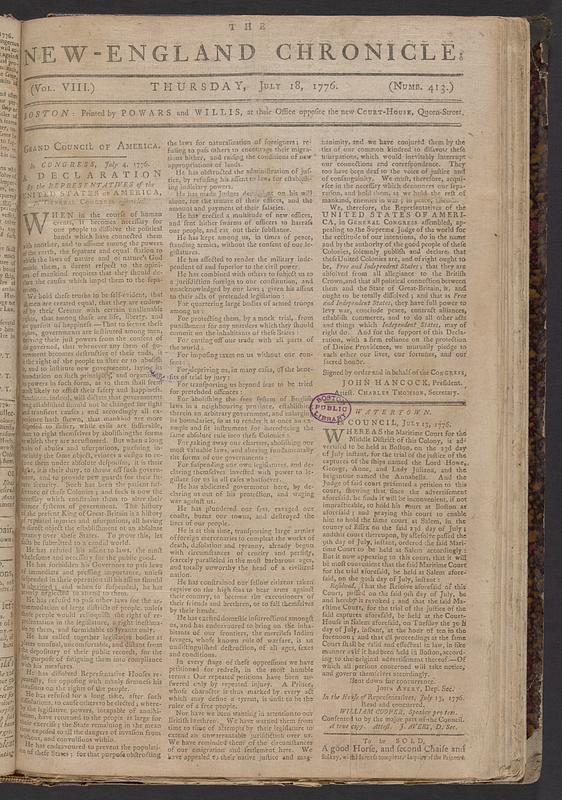
The first Boston newspaper printing of the Declaration of independence
Boston Public Library
Why It Matters
The Declaration of Independence reached Boston on July 13, 1776. Its arrival set off a flurry of activity. Members of the revolutionary government of Massachusetts quickly received a copy in Watertown, where they had been meeting since the British occupation of Boston in 1775.
On July 18, Colonel Thomas Crafts of the Massachusetts militia performed the first public reading of the Declaration in Boston, 14 days after its adoption in Philadelphia. Standing on a balcony at the Old State House, Crafts read out the text for a large crowd who had gathered nearby.
That same day, two Boston newspapers printed the Declaration. Edward Powars and Nathaniel Willis, printers of The New-England Chronicle newspaper, also issued the Declaration as a standalone broadside so that it could be posted in public for anyone to read.
Thinking Routine
OBSERVE: What details make this copy of the Declaration of Independence look official or “real”?
THINK: In 1776, how would people decide whether this document was real or trustworthy?
CONNECT: What do you expect to see on an official document today?
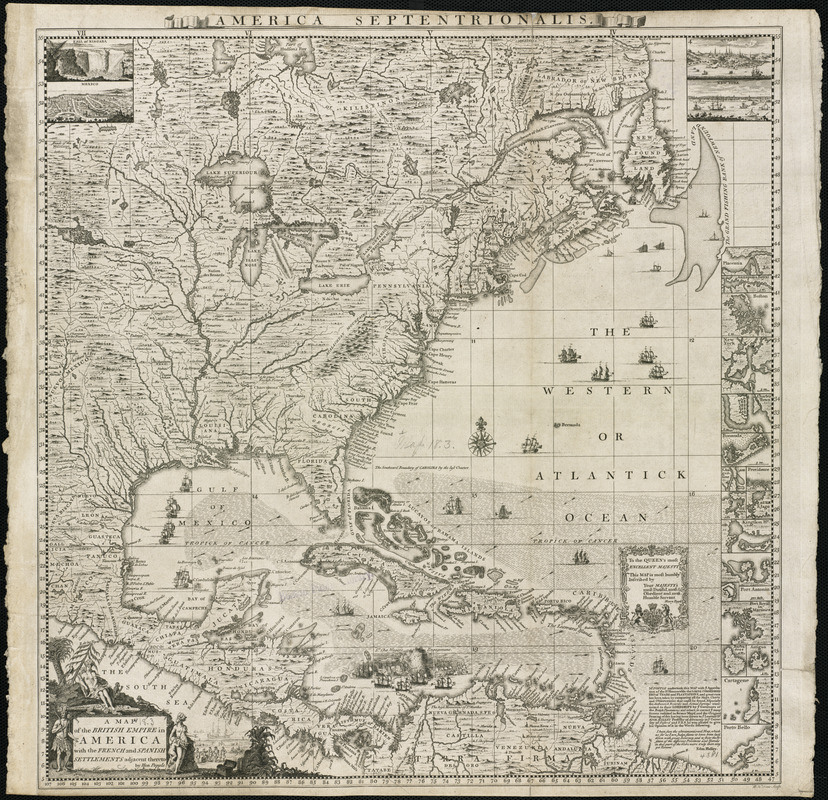
A map of the British Empire in America with the French and Spanish settlements adjacent thereto
The Norman B. Leventhal Map & Education Center
Why It Matters
This map hung on the wall of Independence Hall in 1776, and John Adams mentioned it in a letter to his wife Abigail Adams on August 13, 1776. “Popples Map,” he wrote, “is the largest I ever saw, and the most distinct. …”
When Adams and the other delegates gathered in Philadelphia, they still saw themselves as citizens of their own individual colonies as well as the larger British Empire. But when they signed the Declaration of Independence, they took the first steps towards creating a new political territory.
Thinking Routine
OBSERVE: This map was made for British colonists in 1733. What does the map tell us about this place at this time? What and who is left out?
THINK: Imagine you are looking at this map in 1776. What information did Adams and his contemporaries need to form a new nation when they looked at the map?
CONNECT: Based on what you know about the United States in 1776, what would you add to the map?
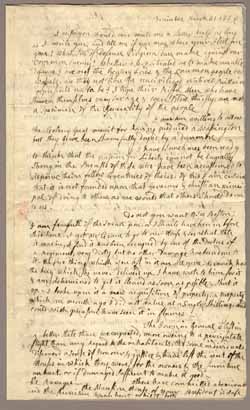
Letter from Abigail Adams to John Adams, 31 March - 5 April 1776; MHS Collections Online: Letter from Abigail Adams to John Adams, 31 March - 5 April 1776
Massachusetts Historical Society
Why It Matters
In the spring of 1776 Abigail wrote a letter to her husband John, who was then attending the Continental Congress in Philadelphia. In this letter, Abigail urges John to "Remember the ladies" and protect women's rights in the new American government. John was in the midst of formulating his ideas about the types of governments to be organized in the former colonies and in April published his essay Thoughts on Government. In Massachusetts, the British evacuation of Boston on March 17 freed American minds to think about their future, government, America's relations with foreign powers, slavery, and the status of women.
It is important to note that this was a private letter when written – it was never published. Abigail sent it to John and wrote to Mercy Otis Warren about her ideas. Abigail was a political advisor to John, but this letter did not become widely known until much later. Nonetheless, she would not have been the only woman thinking about their place in this new nation-to-be; we just happen to have her ideas recorded.
Thinking Routine
OBSERVE: What does Abigail Adams want for women in the new nation?
THINK: Abigail is writing privately to her husband, John. How is a private letter different from a newspaper article or a public speech?
CONNECT: How do people ask people in power for change today?
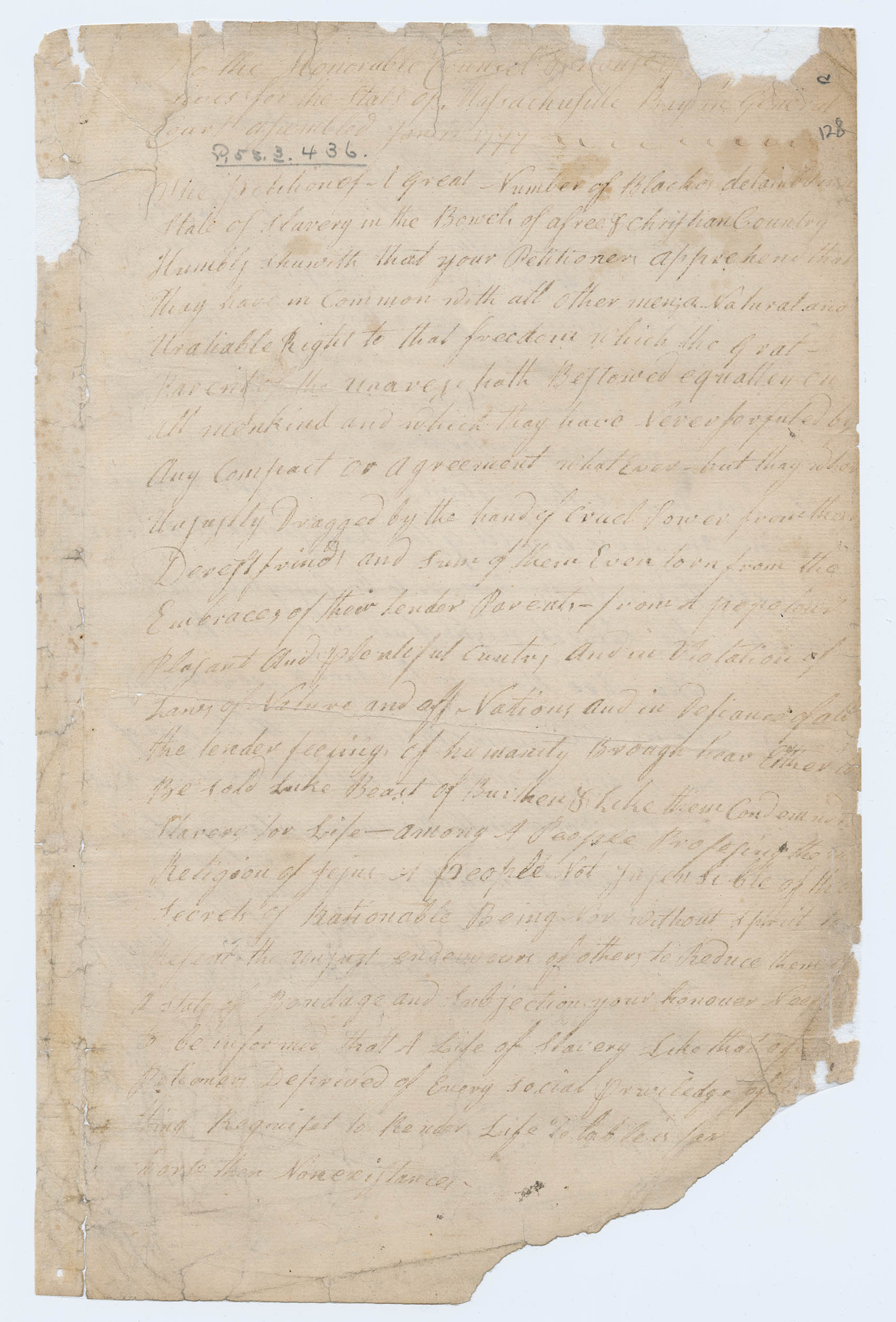
Freedom Petition written by Prince Hall and 7 other free Black men, 1777
Massachusetts Historical Society
Why It Matters
In this petition, "A Great Number of Blackes" of Massachusetts state their case for freedom, suggesting that this is the natural right of all people. This handwritten draft is based on the official petition submitted to the legislature (and is part of the Massachusetts Archives). It is dated January 13, 1777 and was written by Prince Hall (1735-1807) and seven other Black men from Boston.
Free and enslaved Black men submitted 8 freedom petitions (that we know of) to the Massachusetts legislature and governors between January 1773 and January 1777. These petitions applied the same ideals about of the American Revolution on natural rights but did not limit them to colonial independence; for these authors, ending slavery and the slave trade in Massachusetts was just as important as achieving independence from Great Britain.
Thinking Routine
OBSERVE: What do the men writing the petition want?
THINK: How do the writers present their argument? What type of language do they use in an official petition to the government?
CONNECT: How do the writers connect their ideals about rights to the Declaration of Independence?
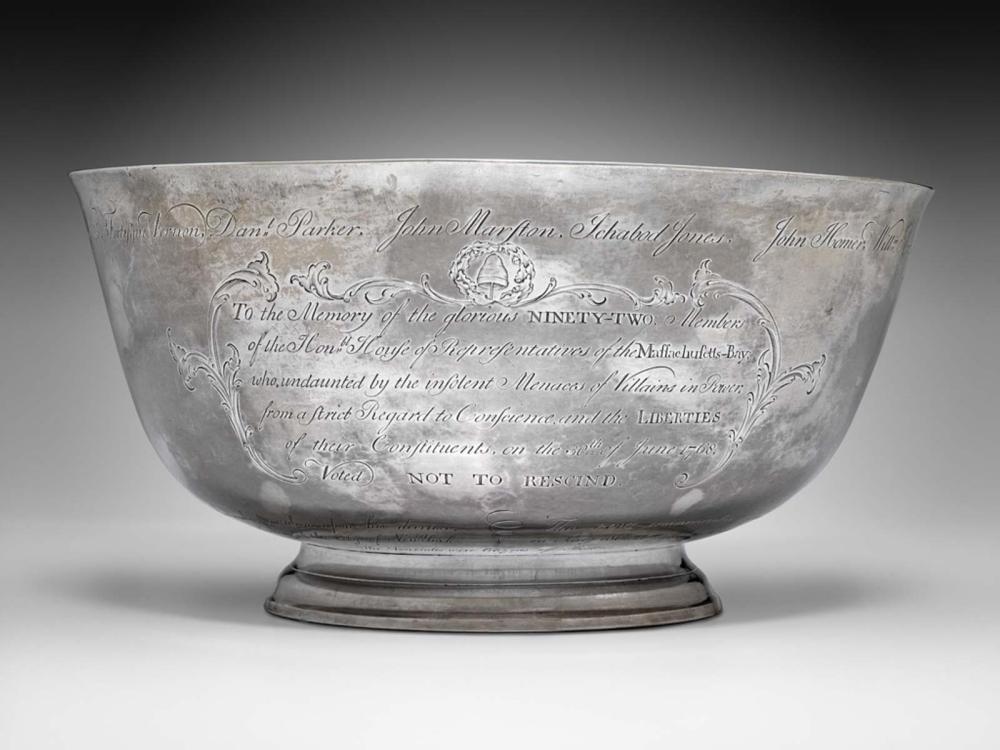
Sons of Liberty bowl, Paul Revere, Jr. (American, 1734–1818), 1768
Museum of Fine Arts, Boston
Why It Matters
The Sons of Liberty bowl was crafted in 1768 by the Boston silversmith Paul Revere (years before his legendary midnight ride and the beginning of the American Revolutionary War). The bowl was commissioned by fifteen members of the Sons of Liberty, a revolutionary organization made up of white men that opposed British rule, and would likely have been used during their meetings.
The bowl honored ninety-two members of the Massachusetts House of Representatives who refused to rescind a letter sent throughout the colonies protesting the Townshend Acts (1767). The bowl chastises the British authorities—or, as the engraved inscription puts it, the “insolent Menaces of Villains in Power”—who levied taxes on the colonies without their consent. This act of civil disobedience by the "Glorious Ninety-Two" was a major step leading to the American Revolution.
Also engraved on the bowl are references to Englishman John Wilkes, whose writing in defense of liberty inspired American patriots.
Thinking Routine
OBSERVE: Take a moment to observe the inscriptions and designs on the silver bowl. What did you notice after looking closely?
THINK: How might the bowl help us to understand how the Sons of Liberty were thinking about rights and power in 1768?
CONNECT: What ideas about freedom do you think this bowl is showing us?
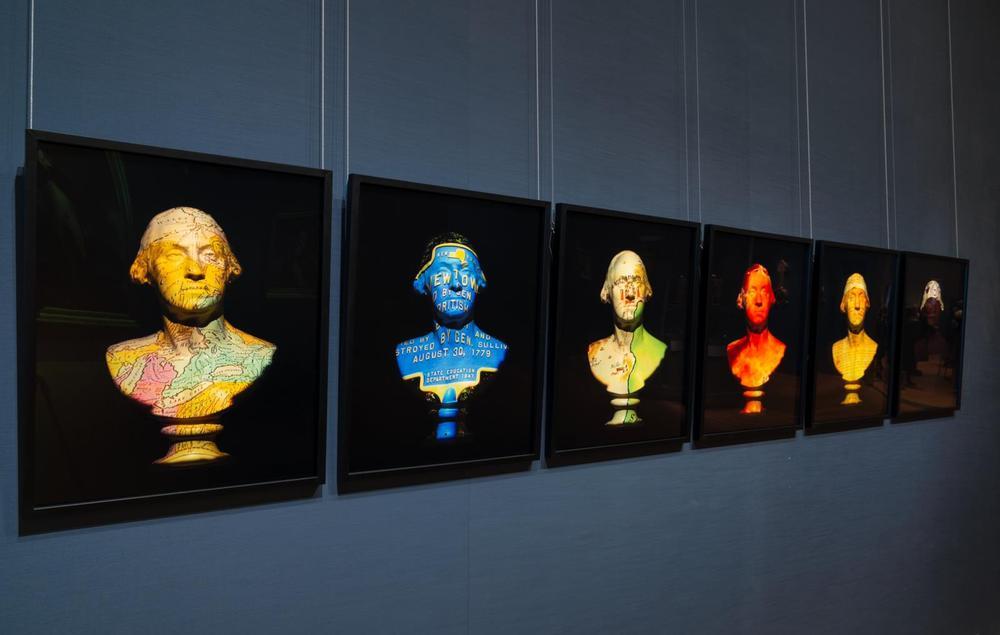
Hanödaga:yas (Town Destroyer): Whirlwind Series, Alan Michelson (American, born in 1953), Native American, Mohawk, Six Nations of the Grand River, 2022
Museum of Fine Arts, Boston
Why It Matters
What is George Washington's legacy among Native Americans? To the Haudenosaunee, he is known as Hanödaga:yas (Town Destroyer). George Washington earned the title by ordering the brutal 1779 Sullivan-Clinton Campaign, which methodically devastated Haudenosaunee crops and forty villages that sided with the British during the Revolutionary War.
Alan Michelson, a contemporary artist and Mohawk member of the Six Nations of the Grand River, projects imagery of this painful history onto a familiar bust of Washington: colonial maps, an historical marker commemorating the destruction, flickering flames, the 1794 Treaty of Canandaigua between the United States and the Haudenosaunee; and finally, the George Washington wampum belt ratifying that treaty. In this final photograph, Washington almost disappears into the darkness, highlighting the significance of the wampum belt as a representation of Indigenous diplomacy, sovereignty, and survival.
Thinking Routine
OBSERVE: Look at all six photographs in the series. What captures your attention? What looks familiar?
THINK: One photograph shows the Treaty of Canandaigua (1794), signed by George Washington confirming peace between the United States and the Haudenosaunee (Six Nations). What is the message when the artist includes this treaty alongside images of destruction? By including the treaty in his artwork, what message might the artist be relaying to the viewer?
CONNECT: What is the artist asking viewers to reconsider about George Washington and this period of history?