We’re excited to introduce Artem Sereda to the LMEC community as our Fall 2025 Visitor Service & Operations Assistant! Artem joined us this July as a Northeastern Co-op student and is currently an undergraduate candidate for a BA in History. Now at the end of his co-op term, we sat down with Artem to learn more about his interests, work at the Center, and how YouTube videos contributed to a lifelong love of geography and history.
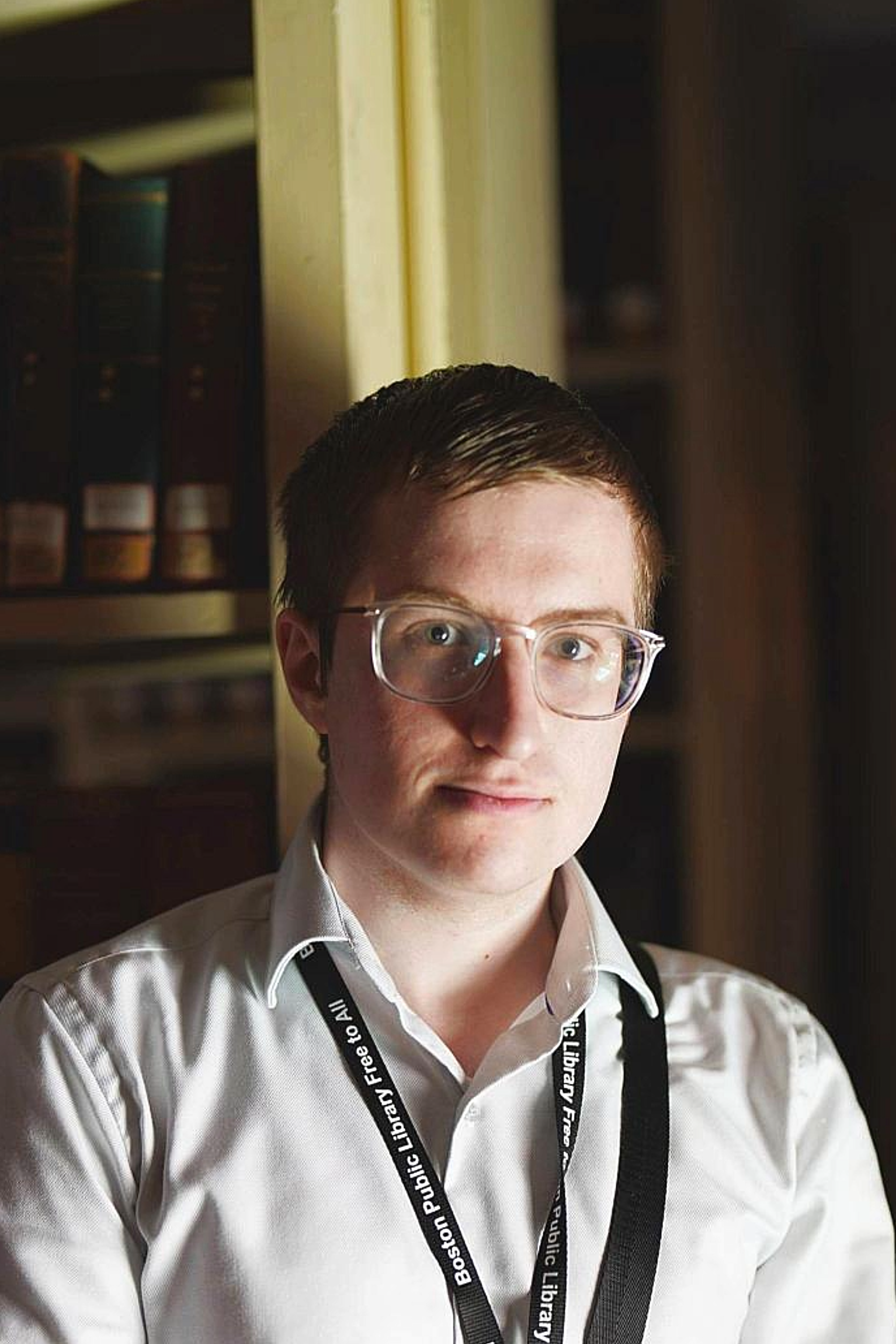
Artem, we loved having you as an essential piece of the Leventhal Map & Education Center team! We’re curious, what are you currently studying at Northeastern and what made you choose to work at the Leventhal Center during your co-op experience?
Thanks, it’s been a genuine pleasure working here! I’m in my fourth year of studying history, so you might imagine why I’m interested in maps. I consider myself a visual learner and, for studying history (as well as contemporary politics), I’ve found maps to be an invaluable tool. Plus, they’re just really fun to look at.
I was on board pretty much as soon as I found out I could professionally nerd out about maps. I used to give tours at the State House, and I’ve found the experience very gratifying, I was excited to do something similar. I also plan on pursuing further academic work in the future, so it was nice to get a bit of experience with archival work and primary sources.
As a Northeastern co-op student, you were with us for six months! This question was asked during the beginning of your time with us: What things are you most looking forward to during this time at the Leventhal Center?
I’m looking forward to doing my own tours. I’d love to find some creative ways to tell people about our exhibits, especially when it comes to adjusting to different demographics. I also like how much possibility there is for different projects. I would love to do some research in the collection—it’s amazing how much interesting material can float up when you’re trying to find something specific. I would also love to contribute to LMEC’s process of making maps more publicly visible, be it through showcases, online tools or social media.
You started with us during Terrains of Independence, just a few days before the 4th of July. Are there any parts of the current exhibition that you’re especially drawn to?

In general, I love reading about historical wars and battles that took place in and around major cities; the landscape forces rivals to adopt unique strategies, and contend with the civilian population as a major factor. “The seat of war in New England, by an American volunteer" map especially caught my attention for how detailed it is, and how the details of troop marches and supply trains is something you won’t find on every city map. The use of multiple scales at once (state, city, bay) fits really well with the way the exhibit is laid out, and also gives a really nice picture of Boston’s direct role in the Revolutionary War.
What I also love is that, despite having a lot of flourish and illustration, this map was actively used by the contemporary military, making it kind of a window into the strategic outlook of British and colonial leaders. The accompanying exhibition text provides some great context about the involvement of different social groups and other less famous actors in the Revolutionary struggle.
What is your earliest memory of maps? Have maps influenced your life in any particular way as an adult?
The first memory that comes to mind is a school project where we had to memorize Magellan’s path around the globe. I was 11 years old back then and mostly perceived the map as a series of random shapes with labels on them, so finding Spain was tough.
Maps were also the catalyst for my interest in history in form of simple YouTube "infotainment" videos; I was gripped by colorful animated maps visualizing warfare, commerce, and the shifting of nations. Geography, for me, went side by side with history. I also started making maps for my own fictional worlds, a hobby I still pursue to this day. The great thing about maps is that they always raise more questions, which is something that both writers and historians thrive on. Also, I have no directional awareness, so I would literally be completely lost without Google Maps.
Do you have a favorite map that you’ve found in the collection?

Louis Bretez, Plan de Paris: commencé l'année 1734 [Turgot map of Paris] [1739?]
A map I’ve found before I got here and only later learned was present in the LMEC collection is the Turgot map of Paris from 1734. It’s a huge bird’s eye view style plan of Paris, divided into many fragments. I love this map because, overlaid on the city plan, there are highly realistic drawings of major street façades, government buildings, and other notable structures. Paris at this time was one of the largest and most important cities in the world, so it’s incredible that we can see what is practically a satellite image despite the fact that nothing close to aerial photography existed yet.
How do you see this co-op informing or influencing your plans for after college and your future career?
I’ve already decided I’m interested in pursuing a history-related career in the future, and I'll probably attend grad school. I’ve been looking at both academic work and public history as possible career options, and I’ve gotten some experience with both at the LMEC. I really enjoyed participating in the behind-the-scenes environment of a collection & gallery, and I’ve felt like everyone here is passionate about geography, history, and maps. I hope to find a similar environment to work at in the future.
Aside from your regular duties and work responsibilities, what was your favorite part about working at the LMEC?
Coming in, I was a bit worried about the amount of social interaction I’d have to do at the desk, but it actually turned out to be one of my favorite parts of the co-op. I find it very gratifying when people get excited about things that I myself am passionate about, and that is something that happens a lot in the gallery. Even when I’m not giving tours or answering questions, it puts a smile on my face to see visitors being impressed by the Leventhal Center gallery.
As your co-op comes to an end, do you have any advice for future LMEC co-ops?
I would recommend figuring out your own schedule for completing projects and other work you’re doing. There’s plenty of things to do and you’ll have time to work both on and off desk. However, you generally get a lot of freedom in how you do them and when, so it’s valuable to figure out your own pace. I feel like I could’ve accomplished more with a couple of projects if I’d managed my time more efficiently.
Additionally, I recommend finding a mirror to stand in front of and practicing confidently proclaiming “Sorry, I don’t know the answer to that question.” There’s a few times where I wish I’d done that instead of giving an inconclusive answer!
Our articles are always free
You’ll never hit a paywall or be asked to subscribe to read our free articles. No matter who you are, our articles are free to read—in class, at home, on the train, or wherever you like. In fact, you can even reuse them under a Creative Commons CC BY-ND 2.0 license.